Showing posts with label Bellevue Estate Planning Attorney. Show all posts
Friday, June 1, 2012
Clarifying the "Whos" and "Whats" of the Estate Planning Process
As you go through the estate planning process, it is easy to become confused with the different names assigned to different roles. You will name an attorney-in-fact, executor or personal representative, guardian and trustee if you have minor children, and a successor trustee if you have a trust. In addition, different documents are used to name the persons you choose for these roles. The chart below is a reference for you to help keep straight "who" does "what".
As always, I'm here to answer your questions. Call me at (206) 923-9356 or email me at mailto:info@insightlawfirm.com if you have questions about this article or would like to schedule an appointment.
Alerian Hall is an estate planning attorney in Seattle, Washington. Alerian Hall’s financial expertise (she was previously a financial advisor) enables her to provide a truly comprehensive and tailored estate plans for her clients. Visit Insight Law’s website to learn more.
www.insightlawfirm.com
Author: Alerian Hall
Estate Planning Attorney
Will Lawyer
Trusts Attorney
Probate Attorney
Tax Attorney
Tax Lawyer
Bankruptcy Attorney
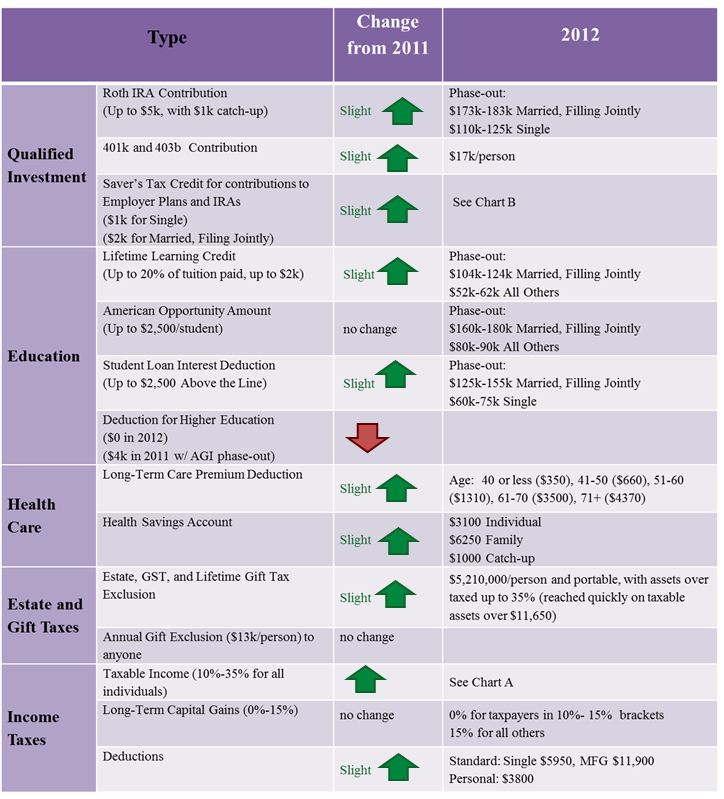
2012 Quick Summary Chart of Tax Changes
Here’s a chart designed to give you a quick overview of the 2012 tax changes that are most likely to affect the average person.
Let us know if you have any questions.
Charts showing more detail on Income Taxes (Chart A) and the Saver’s Tax Credit (Chart B) follow the main chart.
Author: Alerian Hall
www.insightlawfirm.com
Estate Planning Attorney
Will Lawyer
Trusts Attorney
Probate Attorney
Tax Attorney
Tax Lawyer
Bankruptcy Attorney
Who should you choose to be your attorney-in-fact, guardian for children and executor?
Choosing people to fill these fiduciary roles is a big decision. If you are struggling over this issue, here's a summary of qualities to consider as factors. You'll also need alternates and second alternates.
As always, I'm here to answer your questions. Call me at (206) 923-9356 or email me at mailto:info@insightlawfirm.com
Alerian Hall is an estate planning attorney in Seattle, Washington. Alerian Hall’s financial expertise (she was previously a financial advisor) enables her to provide a truly comprehensive and tailored estate plans for her clients. Visit Insight Law’s website to learn more.
Author: Alerian Hall
www.insightlawfirm.com
Estate Planning Attorney
Will Lawyer
Trusts Attorney
Probate Attorney
Tax Attorney
Tax Lawyer
Bankruptcy Attorney
Probate: What You Need to Know
What is probate?
Probate is a legal process using the court system following your death where your Personal Representative settles your estate. The following occur in probate:
- Your Will is filed with the court
- An inventory of your estate is made
- Appraisals of property may need to occur
- Debts are paid
- Taxes are file and paid
- You Will is proven to be valid
- Your heirs are given notice
- Your assets are distributed to beneficiaries
Probate generally takes over a year, which gives time for the above steps to occur, as well as time for creditors to collect (creditors have four months if publication of notice, and up to two years if no publication).
What assets are affected by probate?
Assets can be transferred to your beneficiaries upon your death in 2 different ways depending on what type of asset they are. First, some types of assets (see the assets listed in the left column below) are transferred directly to your beneficiaries based on the beneficiary designation you put on those assets. On the other hand, some types of assets (see the assets listed in the right column below) must go through probate, a process in which a court determine what your intentions were based on your will (or the rules of intestacy if you have no will).
It depends. Assets that go through probate will generally take longer to get to your beneficiaries. Also, probate can be expensive (attorney fees, filing fees, etc.) and a hassle for your Personal Representative. However, probate can be a good thing- especially if you have significant unusual debts, pending lawsuits (or potential professional liability), or a failed business. Also, very small estates have simplified (and therefore cheaper) procedures to follow. Families that are unclear on the entire financial picture of the estate may also want to go through probate to have the court sort everything out for them.
How can I avoid probate?
Use Proper Beneficiary Designations. First, a lot of your assets (see the list in the left column above) already avoid probate, if you have done your beneficiary designation correctly. However, most people will not correctly list their beneficiaries. For that reason, sometimes these assets will end up going back through probate or will not go to the beneficiary you intend. It is essential you check all of your beneficiary designations to make sure they align with the estate planning we do.
Transfer Assets to a Living Trust. Second, other assets that normally go through probate can avoid probate if you transfer ownership of them from your name into a revocable living trust. This trust will generally be called something like "The Smith Living Trust." This trust is a fairly simple way to avoid probate, and is frequently used for out-of-state property (to avoid going through probate in 2 states).
Change the Ownership Form of Jointly Held Assets. Finally, some assets that you hold jointly as “Tenants in Common” can be converted into an ownership form called “Joint Tenancy with Rights of Survivorship.” These assets would then pass directly to the other owner (a.k.a. the "joint tenant") upon your death, and vice versa. This is an easy solution when you want your spouse or RDP to receive the assets outright, but is not an available option for many types of assets. A Community Property Agreement can also be useful tool. These ways of changing of ownership will generally override your will provisions, so it is essential to discuss this with me prior to making these changes.
How do I control who gets my probate assets since there is no beneficiary designation for those assets?
A Will states your intention for who gets most of your probate assets (in addition to who you want as your Personal Representative). However, for some assets, like your pets and furniture, you must create a list of these outside of your will. Since this list doesn’t need to be witnessed, it’s a good idea to write it out in your own handwriting (to show that you really created it).
STILL HAVE QUESTIONS? Please contact me. I’m happy to help (there’s no fee to chat with me). My email is mailto:info@insightlawfirm.com, and our website is http://www.insightlawfirm.com/.
Tuesday, May 29, 2012
Insight Law | Bellevue Estate Planning Attorney | Bellevue Wills Lawyer | Bellevue Probate Attorneys | Trusts Lawyers Bellevue WA
Insight Law is a dedicated Bellevue Estate Planning Law Firm that serves all of East King County including Redmond, Bothell, Kirkland, Issaquah, North Bend, Sammamish, And Fairwood. Call Today For a Free Consultation at (425)462-6390.
Please click "Home" to read our blog. Click "About" to learn about our firm. Click "Locations" to get a map and directions to our four convenient locations. Click the link below to visit our firm website.
Insight Law - Bellevue Location:
800 Bellevue Way NE Suite 400
Please click "Home" to read our blog. Click "About" to learn about our firm. Click "Locations" to get a map and directions to our four convenient locations. Click the link below to visit our firm website.
Insight Law - Bellevue Location:
800 Bellevue Way NE Suite 400
Bellevue, WA. 98004
(425)462-6390Naming Minors as Beneficiaries on Your Life Insurance Policies & Investment Accounts
Article Overview:
1. Life insurance and financial accounts generally have beneficiary designations forms you fill out when you open the account. Who you state as your beneficiary on these forms is to whom that account goes, regardless of what you state in your Will.
2. Don’t list your young children as outright beneficiaries on these forms.
3. Instead, use “trust” language, taken from your Will.
4. Don’t worry- this is a straightforward and inexpensive solution.
Full article:
Do you currently have your children or other minors named outright as beneficiaries on your investment accounts or insurance policies?
For example, after your spouse, you list your children as:
My Children
or
Joe Smith, 50% and Jane Smith, 50%
or
My Estate
Oops! You don’t want to do that!
Minors generally cannot own property and financial accounts outright. As a result, if you die before your child turns 18, the court appoints a guardian (not automatically the surviving parent) to manage these assets until the minor turns 18, at which point the minor has full access and control. In other words: bureaucracy, court fees, and 18-year-olds flush with money may result! Furthermore, if you leave qualified assets such as 401(k)s and traditional IRA(s) outright to minors, higher taxes may also result.
So, instead, do these 2 things:
1. Fix Your Will. Include language in your Will authorizing a trust, and then,
2. Fix your Beneficiary Designations. Reference that language on your assets’ beneficiary designation forms.
Don’t worry- this is neither complex nor expensive.
What the trust does:
If both parents die when the child is young, the trust can help:
- Protect your children in a catastrophic event.
- Ensure your children’s inheritance money is used wisely— i.e. on college, not parties.
- Avoid court intervention.
- State who you want to be your child’s guardian. Otherwise, grandparents are generally the default if both parents die.
You’ll have a choice between 2 types of trusts:
1. Children's Trust
For most parents, I recommend a children's trust, which is flexible and inexpensive.
2. UTMA Trust
For most other situations, I recommend a trust created under the Uniform Transfer to Minors Act (UTMA); it’s less flexible and customizable, but it is simple and generally included in your will at no extra cost.
The Bottom Line:
With a bit of effort and minimal cost (you needed that Will done anyway, right?), you can avoid the legal and tax pitfalls that often result from unintentionally problematic designations on your financial accounts and insurance policies.
One final thing about financial accounts…
Finally, when you check your bank and brokerage accounts that are held jointly, look at how they are titled— Tenancy in Common (TiC) or Joint Tenancy with Rights of Survivorship (JTWRS). This really matters! If any of the accounts are held as JTWRS, the other person listed as account holder gets the entire account at your death, regardless of what you put in your Will. Make sure that this matches your intention for those assets.
Alerian Hall is an estate planning attorney in Seattle, Washington and is of counsel to Insight Law. Alerian Hall’s financial expertise (she was previously a financial advisor) enables her to provide a truly comprehensive and tailored estate plans for her clients. Insight Law is a tax planning firm with 4 locations in the greater Seattle area. Visit insightlawfirm.com to learn more and to schedule an appointment.
This article is for general informational purposes only and does not constitute legal advice.
Author: Alerian Hall
www.insightlawfirm.com
Estate Planning Attorney
Will Lawyer
Trusts Attorney
Probate Attorney
Tax Attorney
Tax Lawyer
Bankruptcy Attorney
Subscribe to:
Comments (Atom)